Clamp Meter: The Ultimate Guide to Non-Contact Current Measurement
Clamp Meter: The Ultimate Guide to Non-Contact Current Measurement
A clamp meter is one of the most versatile and essential diagnostic tools for electricians, maintenance engineers, HVAC technicians and industrial professionals. Unlike a standard multimeter that requires circuit interruption for current measurement, a clamp meter allows you to measure current flowing through a conductor without breaking the circuit or making physical contact with live wires. This non-invasive capability makes it indispensable for troubleshooting, preventive maintenance and safety compliance across industries. In this comprehensive guide, we cover everything you need to know about clamp meters — from how they work and the different types available, to key features, real-world applications and a detailed buying guide to help you make the right choice.
👉 Looking for a professional clamp meter? Check out the Kusam Meco KM2775 2000A AC / DC Clamp Meter from IndiaMeters.
What is a Clamp Meter?
A clamp meter, also known as a clamp-on ammeter or current clamp, is an electrical test instrument that measures alternating current (AC) and, in advanced models, direct current (DC) without requiring the circuit to be disconnected. The distinctive jaw or clamp at the top of the meter opens to encircle a single conductor, and the meter displays the current reading on a digital screen. Modern clamp meters have evolved far beyond simple current measurement. Many models now integrate the full functionality of a digital multimeter (DMM), allowing users to measure voltage, resistance, continuity, capacitance, frequency and even temperature. This hybrid capability makes the modern clamp meter a true all-in-one troubleshooting tool.
How Does a Clamp Meter Work?
Understanding the working principle helps you choose the right clamp meter for your application. The measurement method depends on whether the meter is designed for AC, DC or both.
The Current Transformer Method (AC Only)
Basic AC-only clamp meters use a current transformer built into the jaws. The conductor being measured acts as the primary winding, and the coil inside the jaws acts as the secondary winding. When AC current flows through the conductor, it induces a magnetic field that generates a proportional current in the secondary coil. The meter then converts this to a readable current value. This method works exclusively with alternating current because a changing magnetic field is required for induction.
The Hall Effect Method (AC and DC)
For meters capable of measuring both AC and DC current, a Hall Effect sensor is used. This semiconductor-based sensor detects the strength of the magnetic field generated by current flowing through the conductor regardless of whether the current is alternating or direct. The sensor produces a voltage proportional to the field strength, which the meter converts into a current reading. AC/DC clamp meters are essential for applications such as solar panel installations, battery systems, automotive diagnostics and industrial DC drives.
Types of Clamp Meters
Choosing the right clamp meter starts with understanding the different types available on the market.
AC Clamp Meters
These are entry-level meters designed specifically for measuring alternating current. They are widely used in residential and commercial electrical work, HVAC system diagnostics and general maintenance. AC-only meters are typically more affordable and perfectly adequate for most standard electrical troubleshooting tasks where DC measurement is not required.
AC/DC Clamp Meters
Equipped with Hall Effect sensors, AC/DC clamp meters measure both alternating and direct current. They are essential for modern applications involving renewable energy systems, electric vehicles, battery banks, variable frequency drives (VFDs) and DC power supplies. If your work involves any DC circuitry, an AC/DC model is a must-have.
True RMS Clamp Meters
A True RMS (Root Mean Square) clamp meter accurately measures non-sinusoidal waveforms such as those produced by variable frequency drives, switching power supplies and electronic ballasts. Standard average-responding meters can give inaccurate readings on these distorted waveforms, leading to misdiagnosis. True RMS meters provide accurate measurements regardless of waveform shape, making them the industry standard for modern electrical environments.
Flex Clamp Meters
Flex clamp meters use a flexible Rogowski coil instead of rigid jaws. The flexible coil can be wrapped around awkwardly positioned conductors, bus bars or tightly packed cable bundles. These meters are ideal for crowded panel boards and large conductors where standard jaws cannot fit. Flex meters typically offer wide measurement ranges and are often used in energy auditing and load monitoring applications.
Key Features to Look For
When evaluating clamp meters, consider the following essential features:
- Measurement Range: Ensure the meter can handle the maximum current you expect to measure. Typical ranges span from 0.1 A to 1000 A, with some industrial models reaching 3000 A.
- Auto-Ranging vs Manual-Ranging: Auto-ranging meters automatically select the correct measurement range, simplifying operation. Manual-ranging meters offer more control but require the user to set the appropriate range.
- CAT Safety Rating: Look for CAT III (distribution level) or CAT IV (utility level) ratings for industrial and high-energy environments. These ratings indicate the meter's ability to withstand voltage transients.
- Data Logging and Connectivity: Advanced meters offer Bluetooth or USB connectivity for data logging, trending and reporting. This is valuable for energy audits and preventive maintenance programs.
- Backlit Display and Work Light: Essential for working in dimly lit panels, basements or outdoor environments.
- Inrush Current Measurement: Captures starting currents in motors, compressors and transformers — critical for troubleshooting nuisance tripping.
- Jaw Opening Size: Standard jaws open to about 30–40 mm. For larger cables, look for meters with wider jaw openings or consider a flex clamp meter.
Common Applications of Clamp Meters
Clamp meters are used across a wide spectrum of industries and tasks:
- HVAC Diagnostics: Measuring compressor starting currents, fan motor loads and overall system draw to identify failing components or refrigerant issues.
- Industrial Electrical Maintenance: Monitoring motor currents, checking load balancing across three-phase systems and troubleshooting control panels without shutting down equipment.
- Solar Panel and Renewable Energy: Measuring DC current from solar arrays and battery banks to verify system performance and detect underperforming panels.
- Automotive and EV Diagnostics: Checking alternator output, battery drain currents and DC motor drives in electric vehicles.
- Energy Auditing: Logging current consumption over time to identify energy-saving opportunities and verify power quality.
- Commercial Building Maintenance: Testing lighting circuits, elevator drives, HVAC systems and emergency power supplies.
How to Use a Clamp Meter Safely
Safety is paramount when working with live electrical circuits. Follow these best practices every time you use a clamp meter:
- Always verify that the meter and its leads have the correct CAT safety rating for the environment you are working in.
- Inspect the meter, jaws and test leads for any physical damage, cracks or exposed conductors before each use.
- Select the correct measurement mode and range before clamping around a conductor.
- Only clamp around one conductor at a time. Clamping around multiple conductors (e.g., a full cable) will give a net current reading (typically zero for balanced loads).
- For voltage measurements, always connect the test leads in parallel with the circuit. Never use the clamp meter to measure voltage on a circuit exceeding its rated category.
- Wear appropriate personal protective equipment (PPE) including insulated gloves and safety glasses when working near live conductors.
- After use, turn off the meter and store it in a dry, clean environment to prolong its lifespan and maintain calibration.
Recommended Clamp Meters from IndiaMeters
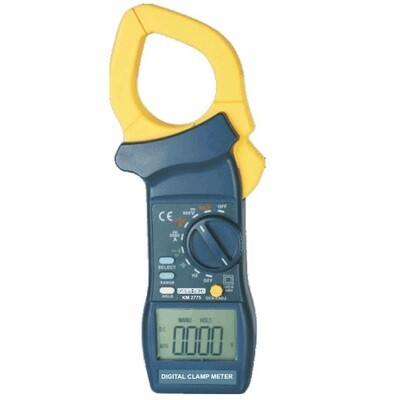
Kusam Meco KM2775 2000A AC / DC Clamp Meter
- ✔ AC/DC
- ✔ DC Current
- ✔ AC Current
- ✔ Temperature
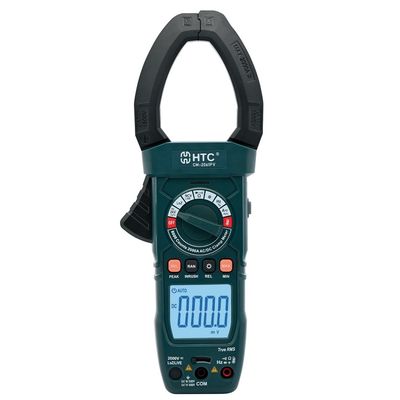
HTC CM-2061PV Solar Clamp Meter
- ✔ True RMS
- ✔ AC/DC
- ✔ DC Current
- ✔ AC Current
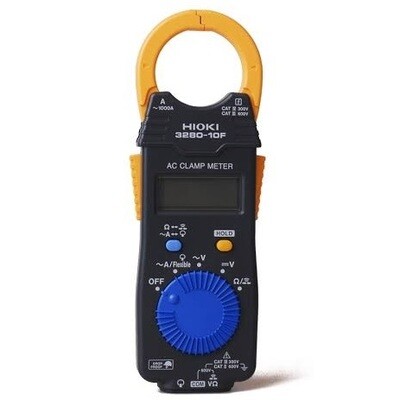
Hioki 3280-10F - 1000A AC Digital Clamp Meter
- ✔ AC Current
- ✔ Frequency
- ✔ Continuity
- ✔ 3280-10F
Types of Clamp Meters at a Glance
| Type | Measurement Capability | Best For | Typical Price Range (₹) | Key Applications |
|---|---|---|---|---|
| AC Clamp Meter | AC only | General electrical & HVAC | 800 – 4,000 | Residential wiring, commercial electrical, HVAC |
| AC/DC Clamp Meter | AC & DC | Solar, automotive & DC systems | 3,500 – 12,000 | Solar panels, battery banks, EV diagnostics |
| True RMS Clamp Meter | AC (non-sinusoidal) | Modern power electronics | 2,000 – 15,000 | VFDs, switching supplies, industrial controls |
| Flex Clamp Meter | AC only (wide range) | Tight spaces & large conductors | 5,000 – 25,000 | Panel boards, bus bars, energy auditing |
| AC/DC True RMS Clamp Meter | AC & DC (all waveforms) | Professional industrial use | 6,000 – 30,000 | Comprehensive troubleshooting, heavy industry |
Buying Guide: How to Choose the Right Clamp Meter
Selecting the best clamp meter for your needs requires careful evaluation of your specific applications, work environment and budget. Here is a step-by-step approach to making the right choice.
Step 1: Identify Your Current Measurement Needs
Determine whether you need AC-only measurement or both AC and DC capability. If you work with solar panels, batteries, DC motors, automotive systems or variable frequency drives, invest in an AC/DC clamp meter with a Hall Effect sensor. For general building electrical work and HVAC, a quality AC-only True RMS meter is often sufficient.
Step 2: Evaluate the Required Measurement Range and Accuracy
Consider the maximum current you will encounter in your daily work. A meter with a 600 A range covers most residential, commercial and light industrial applications. Industrial environments with large motors or heavy machinery may require a 1000 A or higher range. Accuracy is typically expressed as a percentage of reading plus a number of digits. Look for accuracy of ±1.5% or better for reliable diagnostics.
Step 3: Check Safety Ratings (CAT Rating)
The safety rating is arguably the most important specification. CAT III meters are rated for distribution-level circuits (e.g., panel boards, feeders) and are suitable for most commercial and industrial work. CAT IV meters are rated for utility-level installations (e.g., overhead lines, underground feeders) and offer the highest level of protection. Never use a meter with a lower CAT rating than your work environment requires.
Step 4: Consider Additional Measurement Functions
Modern clamp meters often include multimeter functions such as AC/DC voltage, resistance, capacitance, frequency, continuity and diode testing. Some models also feature temperature measurement via a thermocouple probe, phase rotation indication and non-contact voltage detection. Choose a meter with the functions that match your typical troubleshooting tasks.
Step 5: Assess Ergonomics and Build Quality
A clamp meter that is used daily should be comfortable to hold and operate. Look for a well-designed jaw mechanism that opens smoothly, a clear and bright display, and a rugged housing that can withstand drops and harsh job site conditions. Rubberized holsters and IP ratings for dust and water resistance add durability.
Step 6: Set a Realistic Budget
Clamp meter prices in India range from entry-level models under ₹2,000 to professional-grade instruments exceeding ₹25,000. Determine your budget based on frequency of use and required accuracy. For occasional use, a mid-range meter offers excellent value. For daily professional use in industrial settings, investing in a premium brand with reliable support is worthwhile. At IndiaMeters, you can compare a wide selection of clamp meters across all price segments, from trusted brands like Fluke, Kyoritsu, Meco, Rishabh and more, ensuring you find the perfect match for your application and budget.
Clamp Meter vs Multimeter: Key Differences
While many modern clamp meters include multimeter functions, there are fundamental differences between dedicated clamp meters and standard multimeters. Understanding these helps you decide whether you need one or both tools in your kit.
A standard digital multimeter is ideal for measuring voltage, resistance and continuity in low-current circuits, and it excels at precision low-current measurements. However, for measuring currents above 10–20 A, multimeters require shunt resistors that generate heat and limit duty cycle, making them impractical for high-current work. A clamp meter, by contrast, can measure hundreds or even thousands of amps without any heat dissipation issues because there is no direct electrical connection to the circuit. For comprehensive troubleshooting, many professionals carry both a precision multimeter for sensitive electronics work and a clamp meter for power circuit diagnostics.
Conclusion
A quality clamp meter is an indispensable tool for anyone working with electrical systems. Whether you are an HVAC technician diagnosing a compressor starting issue, a maintenance engineer checking motor loads on a production line, or a solar installer verifying panel output, the right clamp meter saves time, improves accuracy and enhances safety. By understanding the different types — AC, AC/DC, True RMS and flex — and evaluating key features such as measurement range, safety rating and additional functions, you can confidently choose a meter that meets your needs for years to come. Explore the full range of clamp meters at IndiaMeters today and equip yourself with a tool that delivers precision, reliability and peace of mind on every job.
Frequently Asked Questions
What is a clamp meter used for?
A clamp meter measures electrical current flowing through a conductor without breaking the circuit. It is widely used for HVAC diagnostics, industrial troubleshooting, solar panel testing, automotive electrical work and energy auditing.
Can a clamp meter measure DC current?
Yes, but only if the clamp meter is specifically designed as an AC/DC model using a Hall Effect sensor. Basic AC-only clamp meters cannot measure DC current.
What is the difference between a clamp meter and a multimeter?
A clamp meter measures current non-invasively by clamping around a conductor, making it ideal for high-current applications. A multimeter requires the circuit to be broken for current measurement but typically offers higher accuracy for low-current electronics work.
What does True RMS mean on a clamp meter?
True RMS (Root Mean Square) indicates that the meter can accurately measure both sinusoidal and non-sinusoidal AC waveforms. This is essential for circuits with variable frequency drives, switching power supplies and electronic ballasts.
What CAT safety rating do I need for a clamp meter?
For most commercial and industrial panel work, CAT III is sufficient. For utility-level installations and outdoor feeders, CAT IV is recommended. Always choose a meter whose CAT rating matches or exceeds your work environment.
Can I measure voltage with a clamp meter?
Yes, most modern digital clamp meters include multimeter functions and can measure AC/DC voltage, resistance, continuity, capacitance and frequency using standard test leads.
How do I choose the right clamp meter for HVAC work?
For HVAC work, look for a True RMS clamp meter with AC/DC capability, inrush current measurement, a wide jaw opening for larger cables and temperature measurement if you need to check superheat and subcooling.
Where can I buy reliable clamp meters in India?
IndiaMeters offers a wide range of clamp meters from trusted brands like Fluke, Kyoritsu, Kusam Meco, HTC and Rishabh, covering all budgets and application requirements with detailed specifications to help you compare.

Comments
Post a Comment